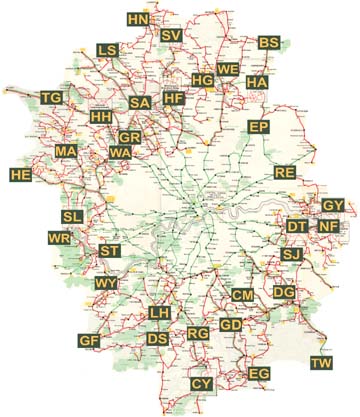
A regular traveller on London Transport buses could hardly fail to notice the prominent racks on both sides of the vehicles, carrying metal stencil plates. One had a pair of letters, the other was numbered. To anyone interested in the operation of the buses they were invaluable, since the letters described the garage from which the vehicle operated, and the numbers described the running number for the duty being covered. In London Country days it became normal practice to paint the garage code in white letters in place of the stencil plate. This was normally a true indication of the home of a bus, but I am told that at least one vehicle from the closed Tring garage defied attempts to reallocate it to Two Waters as the HH mysteriously reverted to TG during the night.
The designation of garages by letter codes was originated by the London General Omnibus Company from 1912. At first the codes were not carried by the vehicles, but from 1934 the London Passenger Transport Board formalised and extended the codes and they were applied across the red, green and Greenline fleets. Some codes were obvious, but others were made obscure by clashes with central area codes. I hope that the list of links will be extended in future.
It was a source of great excitement to travel so far on a Rover ticket that the buses carried garage codes never glimpsed at home. Here is an explanation of all the known country area garage codes, with notes on the garages as available. Unfortunately, there is not a great deal of information available on the country area garages. Until recently, only two books had been published on London Transport bus garages, and both of them covered only the red, central area establishments. Capital Transport have now published a more comprehensive work (by Ken Glazier) in their usual detailed style, but it is about London Transport garages from the formation of the LPTB until 1969 when the operation was divided. Even that was nearly half a century ago, and changes in both the central and country areas have been profound as property values and politics have driven the move to close, re-open or redevelop the valuable town and city sites.
|
|
|
|
More competition came from Thurgood of Ware, a coachbuilder, who traded as People's Motor
Services. It was not until 1934 that London Transport used its powers to compulsorily
purchase this business with its premises in Park Road, Ware. London Transport
continued the General's practice of giving their garages letter codes, and under this scheme
Ware (Park Road) became WE, and the old National garage became WR. After
closure the code WR was transferred to Windsor, to replace its unfortunate WC code signifying
Windsor Castle (or 'Coach').
It was obvious that better and more spacious premises were required, even before the takeover.
Pressure to amalgamate all the operations on one site was intense, so in a mere six weeks the
new garage at Fairfax Road, Hertford was completed. It opened for business on 2nd January 1935.
It was given the code HG, since other obvious codes were already occupied. The palatial garage
provided accommodation for 65 buses. By the end of that year a run-down area between the town
centre and river was cleared and re-developed as a car park, market and bus station. There were
some passenger facilities in the car park, but it was after the war that shelters and proper
stands appeared.
Notable residents at HG were the experimental full-fronted Q type double-deckers, which were
mostly used on the 310 service to Enfield. Hertford also ran a large fleet of Q type
single-deckers on the Green Line. The growth in services that occurred in the New Towns was
denied to the area, so there was little real change at Hertford until the London Country years.
The urgent requirement for one-man operation resulted in the country area's first double-deck
conversion, using AN vehicles from April 1972. In 1980 the bus station was moved to a site at
the new shopping centre.
Deregulation after 1986 saw the garage pass into the hands of the Parkdale Holdings company, while
the bus services became London Country (North East) Ltd. This unhappy rump of the NBC did not
prosper and was split in early 1989 into operations at Hertford, Harlow and Grays (County Bus
& Coach) and Hatfield and Stevenage (Sovereign). Hertford garage was closed in April 1989 and
redeveloped for residential purposes. A move to Caxton Hill was short-lived as services
dwindled, and finally the vehicles returned to their spiritual home in a yard at Ware. Does
this count as progress?
Initially, the garage was built by the LGOC in 1922 and situated on the south of St.Albans Road at the side of the railway
bridge. Like other northern area garages, the new one at Hatfield dates from New Town days. It stood on the opposite side
of the road from the LGOC shed and was opened early in 1959 and must have seemed lavish after the privations of the old
premises. The garage was closed after the takeover by Parkdale, and now it is occupied by a neat little estate of houses
with easy access to the railway station.
LT ceased to use the garage from 5th September 1934 following rationalisation of sevices in the
area, and the opening of a new garage at Epping. It continued in use by Eastern National.
Although the code was allocated by London Transport, it was never used.
The garage was closed by Badgerline, who purchased the operations of Eastern National from the
management buyout team in April 1990.
GRAYS was the scene of a strange division when the town was cut in half on the formation
of the LPTB. Local services had previously been operated by NOTC and subsequently by Eastern
National, but after 1934 all services were divided with the LPTB keeping services to the west
of the town centre and Eastern National those to the East. Cross-town journeys were no longer
possible!
Since the LPTB had no operating base in the town, hurried arrangements were made to rent the
yard of Seabrooks Brewery, an arrangement that lasted until the new garage, coded GY, in
Stifford Road was ready in February 1935. It could be suggested that the rush resulted
in an inferior facility, because the building was an ugly shed with corrugated walls, and none
of the contemporary style could be discerned in the single-storey office buildings alongside.
Sense prevailed in September 1951 when the local routes of Eastern National were acquired by
London Transport, together with the Argent Street garage (coded GA), staff and loaned
vehicles. From January 1952 a recast route map reunited the divided town, and the Argent Street
garage was closed. Plates bearing the GA code were never carried by vehicles - the rolling stock
was branded with red GY plates, at least in theory. GA was acquired by the Co-Op in 1954 and
subsequently demolished during high-rise redevelopment in the 1960's.
In 1957 a second hangar-like shed was added to GY, together with a new single-storey staff and office
block which ran along London Road. Again, there was no hint of coporate style in the building,
which was a very plain structure with a pitched roof. That the structure was over-enthusiastic
is demonstrated by just how quickly its facilities became redundant - its principal purpose in
the 1970's was as a store for redundant or broken vehicles.
Privatisation in 1986 saw ownership pass to London Country North East Ltd., and County Bus &
Coach in 1989. GY was closed on 17th September 1993 to facilitate clearance of the large site,
and replaced by new premises in West Thurrock. A downturn in the local and National economy
means that the site is still vacant at the time of writing in 2001.
Thanks to LOTS's London Bus Magazine 116 for these details, where pictures of the
garages may be found.
Incidentally, Luton had a third garage at Kingsway, which was the depot of Luton Corporation.
They became motor bus operators in 1932 when faced with the renewal of their decrepit tramways,
and no agreement could be found on how to transfer the operation to any other transport
company. An operating agreement was soon reached with Eastern National on mileage and revenue
sharing which would expire in 1970. Faced with increasing losses and serious recruitment problems,
the Corporation was desperate to rid itself of its buses. After a lot of arm twisting and some
political involvement, United Counties purchased the operation on 4th January 1970. The
Kingsway garage was not included , but was leased for 6 months since it was impossible to
maintain all the vehicles at Castle Street. History shows that the acquisition of this
loss-making enterprise and 77 aged and variously dilapidated and unworthy buses nearly sank
the United Counties company completely.
On 4th December 1976 United Counties took over the operation of London Country's routes 360
(Luton to Caddington) and 365 (Luton to Codicote). Desperate manning difficulties brought the
handover forward from 29th January 1977, when it was planned to close the Park Street West
garage. Ironically, UC were forced to ask Bedfordshire County Council to dip deeper into their
pockets in order to support conductor operation of the routes until 6th March, as one-man
agreement was not possible.
The closure of Luton garage coincided with a complete recasting of the local Greenline network.
The old 712/3/4 routes were abandoned in favour of new 707 and 717 routes between Luton Airport
and London Victoria. The 727 remained unchanged at the time, as it was operated from St.Albans.
Dunton Green was strategically placed to serve the area between Tonbridge, Sevenoaks and Bromley,
and the premises accommodated 12 vehicles on opening in April 1922. It was inherited by LCBS in
1970, and subsequently by Kentish Bus in on 27th April 1987. Management of the services moved
to Maidstone, under the Invictaway umbrella, and eventually that identity was lost in favour of
Arriva Kent Thameside. Dunton Green was closed on 14th February 1998, and services concentrated
upon Dartford and Northfleet garages. A small outstation survives at Tonbridge. Closure day was
marked by a visit from GS56 and GS62, which left through the front doors which had been out of
use for some time previously. The last LT vehicle out? I hope they switched off the lights.
I am informed by London Country Management Services Limited that the garage site is now a row of luxury houses. Thank
goodness it isn't a row of crummy houses!
The original Dartford garage was closed in 1986 and subsequently demolished. The current garage operated by
Arriva Kent Thameside (successors to LCSE or Kentish Bus) was converted from a previous non-PSV use and opened in the same year.
This was reduced to an outstation in 1988 but reverted to a full garage at a later stage, although the offices were sub-let.
Thanks to Keith Nason for that update.
The premises has survived all of the takeovers of the post-regulation years, and is now one of just two garages operated by Arriva Kent Thameside, the final repository of the London Country
(South East) business. A gala day attended celebration of its 80th year of service.
The Slough garages had all closed by 1937, as work progressed. The lavish facilities were never fully utilised as the
services did not grow as had been anticipated, and there was always friction because Windsor was the terminus of so many
workings via Slough. Space was welcomed by all the extra workings and excursions to this popular destination.
As an aside, the old buildings are of interest. Hoyal were a company, originally formed in 1921 as Chalmer & Hoyer
Coachbuilders, in volume coachbuilding for whom H.W. Allingham was sales manager. They were the first to take out the
'Weymann' license (for bodies on Bentley, Austin and Morris cars) as pioneers in using jigging to build wood-framed
bodywork. In 1925 the company was re-named after HOYer and ALlingham, and began to concentrate on bus bodies after the loss
of work from Morris who had developed pressed-steel bodywork, but from 1928 there was great hardship and in 1931 the
business was sold. This may explain the letting of a major part at least of their works to LPTB. Weymann's was also an
interesting business, and located to the North-east on the other side of the railway, where they occupied what was
originally the Bleriot aircraft factory. Initially it built car bodies in fabric over lightweight timber, but diversified
into bus bodies and prospered until 1966. After subsequent use and dereliction the site was cleared completely in 2000 and
has now been reborn for business as Aviator Park.
The new garage was part of a major campaign of improvements in the country area put in progress in 1936, and the nearby
Staines garage was in progress at the same time. The new site was on the south side of Station Road to the west of the
station level crossing, and the layout very similar to the Two Waters building of 1935. Single storey office blocks ran
on each side of the approach road towards the running shed which was set back from the road. The road-end of the
flat-roofed offices bore the now iconic curved and glazed elevation surmounted by a bullseye motif. The running shed had
a steel-truss roof with a great deal of glazing covering a floor of 130 x 110 feet which accommodated 43 vehicles. What
is amzing is that from authorisation of expenditure to opening took a mere 4 months, although official photographs
show that a good deal of finishing work was in progress after opening to traffic.
The last day of operation by London & Country, the company which grew out of London Country (South West), was 25th July 1997.
The day was marked by the attendance of a number of vehicles and personnel from the nearby Cobham Bus Museum. RP90, RF 534,
RF672 and RMC1476 made a representative selection of the garage's earlier vehicle allocation, ably assisted by RM2116.
It is stated that Mike Nash enjoyed the canteen's last ever cooked breakfast, but how he came by it is not. The following
day brought a major revision of routes in the area, with operation being dispersed to Leatherhead and Woking (LH didn't see
two more full years before it, too, was abandoned). For a short while Addlestone became a collecting area for vehicles being
seen off by the new generation of Dennis Darts. The museum was able to secure the LONDON COUNTRY lettering from the side of
the building.
The site of the garage is now occupied by Gleeson Mews, a gated community behind the Addlestone Model Centre. While looking
on Google Maps at the location I was offered a Street View, and immediately I orientated myself after being teleported in I
recognised the pillar and part of the boundary wall adjacent to the Crouch Oak (used to be the Railway Inn, advertising
Isleworth Ales and Stout) car park. Comparison with the July 1936 picture in Glazier's 2006 book shows an absolute match,
and the curious feature of the lower courses of bricks standing on end is a giveaway that nobody would emulate today. It
does carry a fire hydrant sign now, which it did not originally. So a part of Frank Pick's grand design is still to be
found in twenty-first century Addlestone, and a jolly good thing, too!
HATFIELD should be the garage that I know most about since I travelled on vehicles from here most often, but sadly
that is not the case. In fact due to the routeing of the 303 through the town centre, I only glimpsed it rarely when using
the 716 which travelled along the Great North Road. In fact, Hatfield is almost unrecognisable today, as the old Barnet
By-pass, The Stone House, The Comet roundabout and all the blocks of flats have gone under the Galleria shopping centre and
contemporary road tunnel. Many pictures survive of vehicles standing on the forecourt, which faced the sun for much of
the middle part of the day, but I have seldom seen a decent picture of the garage itself.
BISHOPS STORTFORD was deep in the Hertfordshire countryside when The National company first opened
a garage at Dane Street, from where services were operated to Harlow and Epping. From 1921 the
service was extended to Ongar and Brentwood under the LGOC umbrella, and numbered N9. The garage
was soon relocated to South Street, and it continued to serve the National routes operated for
the LGOC and on their own account.
LUTON garage was first established by the LGOC in Langley Road, following the takeover
of the business of Road Motors in 1925. This garage was used for a short while by the LGOC's
agents, the National Omnibus and Transport Company. A new Castle Street garage was built by
National in 1927. Upon their split it was passed to Eastern National, and subsequently to United
Counties in 1952. It was the base of Luton & District Transport - sorry, Arriva serving
the Shires until 2001, when the premises were moved out of town to Chaul End Lane.
LPTB moved its operations to Park Street West upon the acquisition of the
business of Strawhatter coaches, who were absorbed into the Greenline empire in February 1934.
The code letters allocated were LS, signifying Luton Strawhatter - or Luton South. It has been
suggested to me that LN (North) was used by National for their original garage. Note that Castle
Street is a long way south of Park Street!
DUNTON GREEN was the first garage to be opened under the collaborative agreement between
East Surrey Traction Company and the London General Omnibus Company which was signed on 7th July
1921. The terms of the agreement provided 'all the motor omnibuses required' together with all
the 'garages sheds and equipment' required to keep the services operated on behalf of the LGOC
within the London country area. East Surrey paid a proportion of the fares income on a monthly
basis, and leased the garages.
LEATHERHEAD was one of the five garages opened under the collaborative agreement between
East Surrey and the LGOC. It was opened on 1st June 1925, and extended in 1928 to comprise three parallel pitches with
sliding doors opening at right angles onto Guildford Road. The site was adjacent to, and slightly hemmed in by the adjacent
railway embankment. It was deemed inadequate, and lavish plans made for rebuilding in 1936, to which end land on the
'country' end of the site had been purchased. In 1939 those plans were revised and a new, single-storey office and canteen
building was built along the
Guildford Road from the old shed which lost one of its entrance doorways. That access was replaced by a side-entrance for
buses to overcome objections by the local council, who were concerned about vehicle movements onto the road. Part of the
site was concreted to give extended outdoor accommodation, and office space inside the shed was released for vehicles, so
quite an improvement ensued.
By the mid 1950's the expansion was long overdue, and the office accommodation was extended to its final state by building
a second floor with a pitched roof on top of the prewar offices. An improved canteen was one of the upstairs features. The
old sheds remained in position, but the rear parking area was extended again. By the time of closure, the original sheds
had been demolished completely, and a new maintenance shed constructed parallel to Guildford Road, but set back behind a
staff parking area.
In 1988 the Drawlane company purchased LC South-West and after a series of mergers and acquisitions LH was closed on
30th April 1999 by the Arriva Crawley & East Sussex company. After closure, the few remaining duties were dispersed among
Croydon, Guildford, Merstham and Fulwell garages, or to other operators. The building was demolished with extreme haste
only days later.
DARTFORD was one of many garages taken over from other operators in the major shake-up
of services following the formation of the London Passenger Transport Board. Dartford garage was
originally built and owned by Maidstone & District, but was taken over on 1st of July 1933,
along with Northfleet.
NORTHFLEET was one of two garages taken over from Maidstone & District following the
formation of the London Passenger Transport Board. The initial premises were the Dover Road tram sheds, converted to a motor bus garage in 1929.
A new garage was built on London Road, Rosherville by London Transport in 1937, and was notable by being only the second to be provided with full canteen facilities.
Great attention was paid to the increased expense of the 'commodious' garage with its enhanced facilities, which resulted in an inspection visit by Lord Ashfield and cost-cutting principles for future projects.
SWANLEY was the last of the garages opened (1925) under the collaborative agreement between East Surrey and the LGOC. The J in the name drives from the nearby Swanley railway junction.
Facilities were provided for 16 vehicles when it opened, but this was found to be inadequate, and difficult of operation due to its position immediately adjacent to the main Maidstone to London road.
Land was purchased adjacent to the London end of the structure, which allowed a new, rear entrance to be provided to the running shed and additional hard standing, with an administration building separated by the access road.
This was of the typical Holden-Pick design, and still extant today. Unlike other garages of its time, the building was of single pitched-roof design (Leatherhead had three bays).
The garage continued in use by London Transport, LCBS and successor companies until January 1986. Since that time the building has been used by Kentish Bus (8.1986 - 8.1989), Centrewest (1995), Southlands Travel (1998-2005) and GoCoaches (2015- ).
The running shed has been given new cladding and doors, while the administration block has been refurbished. (Thanks to Alan Shields for recent information).
WINDSOR was one of the key traffic objectives for the early operations of the General, and thus had an important part
in the early development of services and garage facilities. A new garage was opened by the Underground group at Windsor
immediately prior to the formation of the LPTB, and this became known as WC (later WR). Complementary to that were the LGOC
garage at Slough, Langley Road (SL) of 1926, rented accommodation at Alpha Street and Premier's Bath Road (SU). Each of these
was used intermittently until 1937 as services were taken over from other operators and consolidated with the new Green
Line routes. All of these were consolidated by extending the Windsor garage to house 120 vehicles. The garage originated
with East Surrey, who had wanted a 100 vehicle faility, but the plan was curtailed to 50 on the basis that it represented
expenditure which the nascent LPTB might not be able to afford. The contract stipulated building the extension within 40
weeks, and included a bus and coach station, waiting rooms and enquiry office.2015 to date
ADDLESTONE was lettered WY because it should have been at Weybridge, but of course it never was.
From October 1930, Green Line coaches had been parked at Weymann's coachworks in Station Road, Addlestone, but in 1932 the
coaches moved to Hamm Lane to a rented shed of Hoyal's that would soon be taken over by Weymann. In 1933 they were joined
by buses which had used Woking (Walton Road), and the arrangement continued until June 1936. Thirty-two buses and coaches
were allocated at that time.