
|
BPH 106H SM106 Restoration 2022B |

|
|
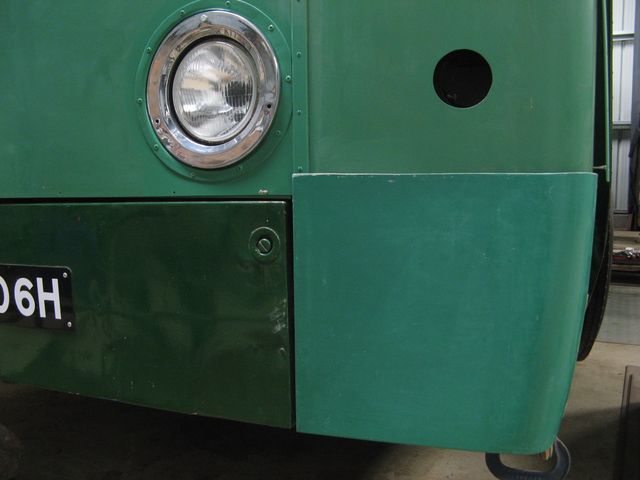
SM106 has not seen a great deal of attention for a few weeks now, what with the Transport Festival and a departure four days later for a week's holiday on the Outer Hebridean island of Barra which included a return voyage and proper Scottish breakfast on the MV Isle of Lewis. Buses were not prominent, though present and frequent enough, but a Macbraynes ferry is a worthy substitute. Back on terra-firma, the job has been all about fettling, polishing and employing the mould for the nearside front corner panel. GRP moulding is quite fun, I have decided, but anybody with experience can look away now. With the gel-coat painted into the mould on a coat of PVA there was time for a cup of tea before the next critical stage. Importance attaches to the setting of the gel-coat to the right condition for laying on the first layer of glass-cloth, which is of medium weight to avoid printing-through the gel-coat. With just the right tack evident, the cloth was laid in and immediately started to adhere which was ideal because I could then use scissors to shape and trim it as required by the curved construction. Resin then poured on and worked-in with a brush and paddle-roller. At this point I diverted from the script and added a second layer of (heavier) glass-cloth into the wet assembly straight away, with more resin and rolling-out. At the 'green' stage the edges of the part were trimmed with a knife so that preparation for fitting would be minimised. After this had cured fully I laid another piece of glass-cloth in to reinforce the strengthening angle on the curved, lower edge while avoiding thickening the areas which would sit on framing parts. There is also the cutout for the foglamp, which could also use a bit of extra weight. The intervening setting time was spent underneath the bus fitting some cleaned and painted parts of the air piping and the low-pressure regulator for the door supply. The run to the gearbox EP valve unit was also followed and partly dismantled so that it too could be cleaned and clipped-up properly. After all that high-stakes activity I was pleased to go home with the moulded part curing ready for its eventual release, which was almost an anticlimax the following morning. It's a simple part with a good release angle formed by the curved edge, so it was expected to be easy and I had a tame photographer on hand to record the event. To be fair, although the project has run for half a year, it could not be progressed for several months until warm enough temperatures prevailed for the resin work.
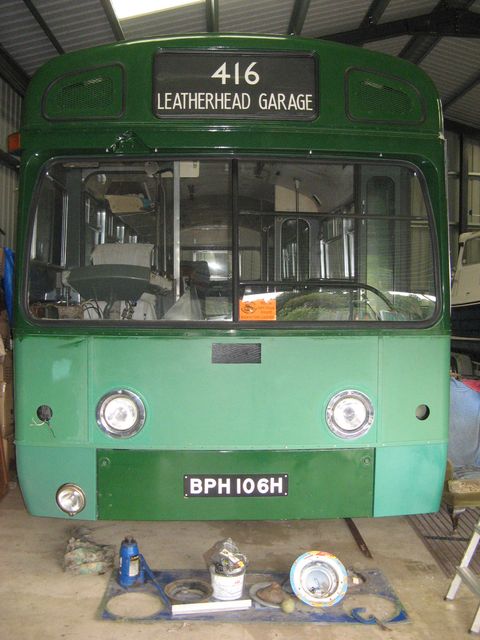
"All very pretty", I hear you say, but does it fit? I don't often get two days at the bus in one week, but with the Platinum Jubilee creating an extra-long weekend, the opportunity was taken to take the new part for fitting on the second day after it was laid-up. Did it fit? Well yes, the first trial was very promising indeed, but allowance had to be made for the fact that it was deliberately made a bit on the large size and needed trimming a bit. Also, the area which wrapped around the corner pillar required the strengthening angle to be trimmed-back substantially. But, for a first attempt, and with no real idea of the shape of the original part I'd say it was a huge success. The finished part wasn't overweight, being thin enough to flex while remaining strong where properly supported. I forsee problems interfacing with the waist panel above it, but that is a legacy problem and one that Park Royal or a subsequent repairer created by having a wooden support rail too thin for the latitude required when screwing in the edge beadings. I am keeping my fingers crossed that it can be persuaded to hold together! The rest of the day was spent in making or drilling the beading parts required to finish the job, finishing the Jubilee holiday weekend on a happy note. Whether any modification to the mould would yield a better result, I cannot say - but yes, a part could be produced in red if required and it should fit a DMS as well.
Apart from some tinkering with short pieces of moulding to attach the corner piece, that job has been paused for a bit. I try to batch jobs like painting so that efficient use of paint and brushes ensues, not that it always works out. The other major omission from the bus at present are the exit doors, so with that's where the focus is for a while, and of course the exit header panel was still in undercoat after the late summer painting campaign last year. I reasoned that it would be easier to finish the header without the doors in place, so applied some carborundum paper and masking tape, and set about the second undercoat, which is really needed because it is difficult to cover the dark-grey etch-primer. While the paint was out, I though that a bit of progress on the adjacent ceiling panel would be worthwhile and generally improving, so that was prepared and covered as well. It really did look better once the gloss coat was done - though I did have to wait for a cooler day due to the warmth of the bus ceiling INSIDE the garage! I reckon it will be worth a second top coat because my paint was a bit sticky, and the preparation is fairly quick. Luckily, I remembered the UFO bowls for the emergency release taps, but still forgot the internal fixing rings. "So it goes", as Kurt would say.
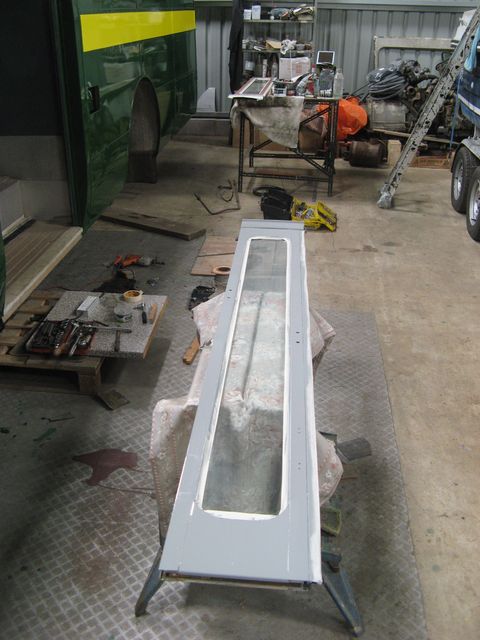
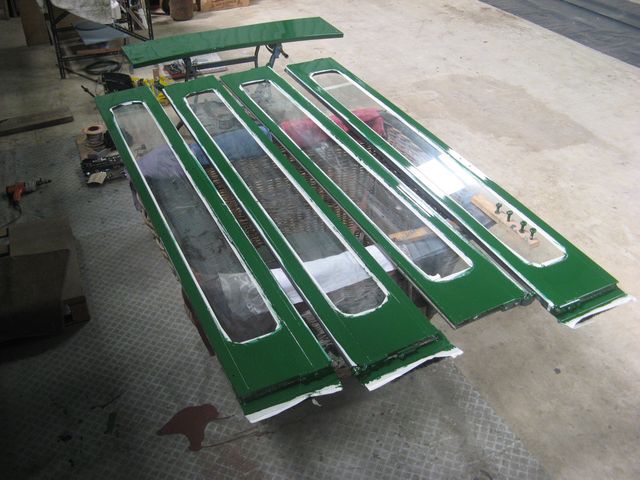
Now the problem with doors, is that as soon as you finish a task on one pair, another comes along in short order! I'll spare you the blow-by-blow account, except to say that I have decided to do the grey side, stand-clear-of-the doors side, inside side of all the leaves before flipping them over to do the green side as one batch. That way I will only need to clean my brush once, instead of twice or three times depending upon the ruling timetable. However, the entertainment during a Saturday attack on the rear pair of door-leaves was Radio 3's afternoon programme of music from the movies. The subject this week was the music of Vangelis, and it was a shock to realise that his career started before SM106 was built (was probably a greater success) and obviously went on a lot longer. The acoustics of the largely empty garage were fabulous, particularly for "La Petite Fille de la Mer" whose haunting melody I find almost entrancing. Bravo for the seventies! The shiny ceiling panels are now decidedly short of the little ventilator cover pressings, so I have started a dialogue to get them blast cleaned of all their rust, muck and old paint so that they too can be brought up to scratch for progressive reinstatement. In the meantime, short, extra sessions have focused on getting the grey coats completed because the project cannot sustain delays of many weeks while the doors are brought up to completion. I have been putting-off the attack on the front, nearside corner pillar because I have been nervous that the extra thickness of the new GRP moulding will push the line of screws too close to the edge of the wooden batten which forms the shape and strength of joint between interior and exterior panelling. Elsewhere it is done with substantial steelwork - in the exit recess, for example. PRV were quite economical with the thickness of the timber which screws onto brackets on the frame (for detail see 2006B) and the curved edges of the front panels hardly meet the centre of the wooden rail, and undoing the screws to admit the new GRP corner has allowed the panelling to open up somewhat. To set the session off to a good start I made a new rain deflector for the rear speaker grille panel. Not complex, but with curves and a bend, and just the right level of complexity that it was a satisfying task to achieve in a short time and boost the success factor. After that the final preparation was done on the deflector, and beading parts for the nearside corner so that it was all nicely dried for painting. Then, only the securing of the nearside dash-panel remained; luckily with a determined left-hand grip and some brisk work with a screwdriver saw all the parts drawn together and screws inserted. Next time it will be done with mastic ready for undercoating! Etch-primer was then applied to all the parts with a scrap of upholstery foam and left to dry. Green undercoating will be done with the exit doors shortly.
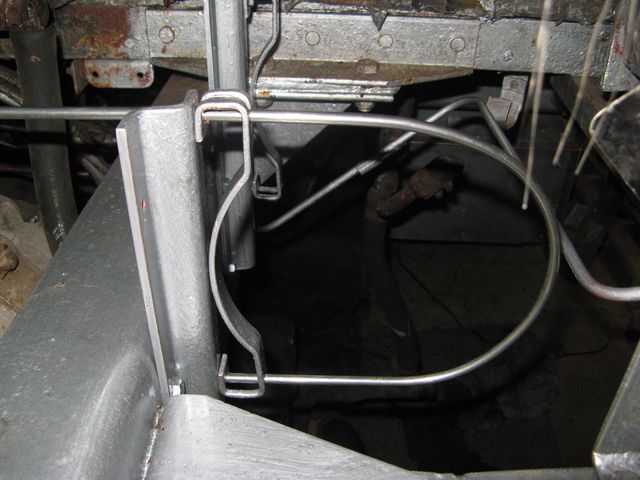
For some unfathomable reason, whenever I try to buy thin metal sheet I am given whatever the supplier has to hand rather than what I asked for. "So it goes". My neatly cut strips one inch wide were lovely, but 1.5mm thick, not 1.2mm, and proved too thick to bend easily to make my new clips for the chassis wiring in its flexible sleeving. Another supplier, asked to cut strips to my requirement simply declined to reply. Another said that it was actually quite difficult to cut thin steel sheet on their guillotine, and then clinched it by saying they couldn't cut anything that narrow anyway. In desperation I purchased a sheet 8 inches square by 1.2mm (my caliper said 1.1mm, which was actually better) through a well-known Web site and set to with my hacksaw. The first strip was a success, and bent quite easily. Thereafter it was just a pleasant, if challenging mental exercise to replicate the bends of an original clip in new metal. A couple had rusted away to nothing, one was capable of salvage and others broke while trying to remove them from the sleeved cables. I always say that there is no shame in old-fashioned benchwork, so hacksaw, hammer, plane and drill brace were applied with vigour, as shown above, to produce a very passable clip. The next ones will be better! All this positivity was only enhanced by having received an updated V5C stating that BPH 106H is now taxed as an HISTORIC VEHICLE, or CERBYD HANESODDOL on the flip-side, Welsh-side. Progress! Earlier there was a picture of the preparation and painting of the grey side of the exit doors, and my determination was to crack-on and deal with the green, livery side in one batch. The other point was that both green undercoat and Lincoln Green gloss had applications in other areas, and they needed preparing in advance of the tin opening. Trimming, drilling, countersinking and screwing the beading over the front dash and lower corners thus became the order of the day, and I am pleased to say it all went well and at the end of a busy day I had inserted 47 screws and undercoated the exit doors AND the entire front dash panel! I thought to myself that moving on to my last tube of non-setting mastic no longer implied that it was time for replenishing the supply, and I enjoyed that feeling as I drove home. The recommendation by Kevin from Wythall of ultra-fine Scotchbrite also turned out well, so the very old paintwork which was to be given a fresh undercoat was clean and smooth for its fresh paint. Masking-up all the four door leaves took a while, of course, and I did not want to repeat the exercise, nor did I want the paint to go really hard, so undercoat and two top-coats were done on succeeding days over one long weekend. Peeling off the tape was a real joy, and the paintwork looked just fine - done entirely with a one-inch synthetic brush. With the doors lying flat a fairly generous coat can be applied, which under ideal conditions flows out wonderfully to leave almost a mirror finish. I also did the towing hatch, which was done for a joke a long while ago, and not well-prepared. The part is so battered thare is no point in going too far, but fixing the chips on the corners will make it look much better, although the slim brush was too small for a good finish on such a big area.
The infamous heat-wave has come late to North Wales, but with painting out of the question other, fiddly tasks have come to the fore. My grand-daughter made a smart comment recently about the lack of a steering wheel, which is because the re-attachment of all the switches to the binnacle still needs to be done. The 24V power supply that I purchased has proved itself at home in testing wiring and indicator lamps, so I am confident that I can rebuild the binnacle without having to take it apart again for the repeater lamps. A stock of 2BA pan-head screws dropped through my letter-box the other day, so it was game-on! A complete set of M2.5 screws, spring-washers and nuts for fixing the row of wafer switches (headlamps, fog-lamps & wipers) has been in stock for a while. I don't like using metric screws on SM106, but I cannot discover what the originals were, and the mismatch between 2.5mm and 2.67mm is of no consequence. Pragmatism rules in this case. They were rather fiddly to assemble, but patience won through and the switch blocks for START, STOP etc. went back easily (the benefit of frequent experiments in the past). There is some work to do on reversing or ameliorating modifications to the wiring, but it's not too frightening, and I have a complete wiring diagram to work to. Thanks, Keith! All this excitement led to the discovery that the indicator turn switch was completely seized, so the arm (loosely attached following painting and other work) was disengaged and all the wiring to switch and horn button was undone. That meant that aggressive preparation could be applied to the alloy casting, followed by a coat of etch-primer. The horn button went home for grey over-painting to be cleaned off. I know it works because I have heard the horn sound when batteries were applied temporarily many years ago. A distant bell was ringing in my mind at this point, and I was able to find the replacement Lucas turn switch which Steve Fennell had sourced (NOS apparently) so that will be fine in due course. All of that was followed by a clean-out of the driver's cab area, so things have moved on in spite of the heat. On my next visit, I continued to rummage through the 'stores' and found another indicator/horn switches casting, with a sensibly pristine horn button. "So it goes", as Kurt would say. The exact origin of some parts is lost in the mists of time, but I did inherit a couple of spare (DMS) binnacles from the wreckage of SMS637 along with a starter motor and a pair of batteries which kept our canal boat going for at least a couple of years. Various jobs presented themselves, particularly the upper draught-excluder brush for the exit doors. The original was in very poor condition due to electrolytic corrosion. The steel-backed brush sits in a channel of an aluminium extrusion, which is pressed to grip it tightly. The corrosion was so bad it had forced the brush out in places! Once again I was able to find an alternative part, but I was a bit puzzled because it sits pointing upwards by default, which is the opposite to the front doors! It was quickly cleaned-up and set aside to dry off. Work on the binnacle has made the mucky condition of the steering column more obvious, with its coat of pale, matt grey flaking off in places. That was soon removed and work with a strip of emery tape prepared it for red oxide, promptly applied after sweeping out the debris. The following session saw grey primer applied to all the areas requiring it, e.g. exit doorway header, indicator stalk, steering-column, draught-excluder etc. but that wasn't enough! After preparation on a previous occasion, green undercoat had been applied to the front dash, so I continued the process and flatted, washed and applied the first coat of Lincoln Green. What a joy to behold! From the right angle, it looks as if we have rolled back 50 years and the proper, early 1970s appearance has been restored. I then started the generator and tested the 24V shore-supply - with good effect. Switching on the circuits at the circuit-breakers, I gave myself a surprise when I turned on the binnacle supply and the horn immediately sounded, due to the wiring touching after removal of the switch button! So far, so good, and time to go home and celebrate.
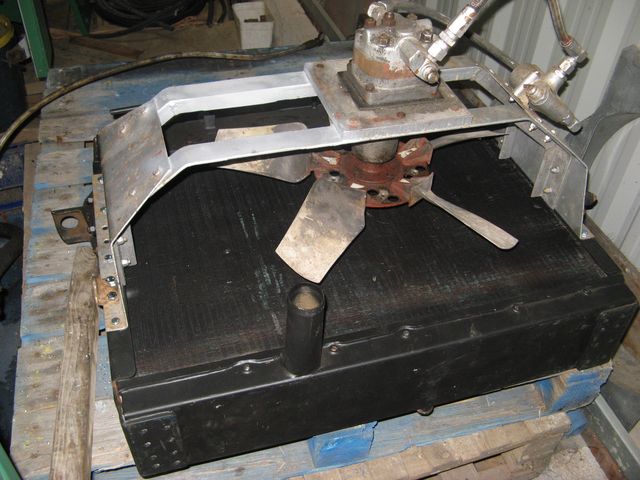
Meanwhile, on the other side of the (Gwydir) Forest the search for a proper paint-job continued, as A.A. Milne didn't say. Basically, until I have chanced my arm and applied a coat of varnish, I cannot apply the insignia and legal lettering which are in stock already, and without which SM106 isn't a proper bus. Having spent so long looking at the shiny, Lincoln Green paint, I am reluctant to spoil it. On the last day of July, I decided that the need for progress ("Fortschritt", as our late teacher of German at Hitchin Boys' Grammar School would say with great emphasis, as we stumbled along) outweighed the pretty sight of a shiny, green bus. First, Chinese Green (grey, of course) gloss was applied to all the bits that required it, then the de-mister air-intake was attached to the front dash with five pop-rivets. After lunch, out came the red Scotchbrite, as recommended by my mentor. It was a real shame to see the shine disappear after I had laboured so long to put a fine finish on the green! A bit of green repair was necessary to the beading below the yellow stripe, where the Scotchbrite had removed some green that was covering yellow that I had not masked off. After a decent interval, the green had touch-dried rapidly in the sensible warmth of the afternoon (that's why the day was chosen) and the varnishing started. My varnish was Coma Berenice by HMG, which, alarmingly, was a delicate mauve colour in the can. It did have a worrying tendency to foam on the roller, but it brushed-out beautifully and I soon got the hang of it, laying-off with a 3" brush, which was only occasionally too wide for comfort. Ashley Blackman doesn't show you how to work around corners in his YouTube videos! Focus was required, and an ideal accompaniment was the BBC Promenade concert by the Ukraine Freedom Orchestra - fabulous at any time, if you missed it. Able at last to stand back, I thought it looked quite presentable, and I was very pleased that the varnish seemed to have a lesser tendency to get in gaps and run. My worst nightmare would be that it had blistered and peeled when I go down next...... I only did the area between the doors as a trial, but it looked fine, with a smoother gloss and is certainly no worse than before. I was exhausted after that, so completed just a few little jobs before packing-up and setting off home. I had cause the other day to dig out my PhotoCD with scans of key 35mm transparencies that I used when starting this web site in the days before digital photography was the norm. The subject that I was interested in was SM128, which was displayed at the Stevenage bus garage open day during the summer of celebration for the Golden Jubilee of Green Line coach services. Back in 1980, SV's SM128 was one of a number of Swifts that were used as training vehicles. Within six months, most were disposed of to Booth's scrapyard, less than 10 years old, and more or less driveable. I often muse, as I lie in the muck beneath SM106, what a lot of very hard work would have been saved by buying one at the time, rather than 25 years later! "So it goes", as Kurt would say, with a sigh. SM128 lives on, as a zombie in the DVLA database, having enjoyed a new life as Nigel the Newsbus, and a putative caravan conversion, but long since lost to view. I was pleased to call by local AEC enthusiasts Buckleys Cranes the other morning to pick up and pay for a pair of refurbished cylinder heads with a complete gasket set which they had found among piles of 'useful' bits in their workshop. Not an opportunity that I should allow to pass unheeded, I decided, especially since the accepted wisdom is that SMS637's engine has a head fault. Thereafter, a happy morning was spent fiddling with re-instating the driver's binnacle - mounting the new horn button and preparing for the new direction indicators switch. Re-wiring for all-round flashing, hazard-warning style, meant that I didn't want to go any further before consulting the wiring diagram, especially as the left-hand repeater is permanently illuminated. Someone has re-purposed the wire, I think, but at least it shows the bulb works. The indicators switch has also been re-wired so that the central lens flashes as a repeater, which is how Lucas intended it! It came to me as I looked at it, that the binnacle was crooked, so I had a go at loosening the nuts on the fixing U-bolt and giving it a twist. It looks much better now, and I expect it will be easier to drive straight in future. The other elephant in the garage these days is the new radiator, which needs drilling so that the fan motor can be mounted. I was reluctant to dive in without understanding more about the routing of hydraulic hoses, so I spent a grubby hour trying to make sense of the pipework which is still in-situ. The gist of it was that I have a complete set of 'return' pipes and reservoir, but no 'pressure' pipes at all. With luck I shall be able to view a working vehicle to see how it should be arranged. That reminded me that I had a bag at home which contains spoils from the dismantling of MBS541, its principal contents being hydraulic hoses. What I discovered when I opened it was beyond my imagining: the hoses, yes, but also a set of 5 fan blades. Even though two were damaged it meant that I had enough to replace 106's broken blade and still have a couple of spares. From time to time I have good reason to give thanks to my father for his engineering nous, recognition and aquisition of parts which had a useful smell about them!
While I was awaiting a customer bringing a boat for storage, and unwilling to start something time-critical or dirty, I applied some of the new vinyl lettering to the finshed, varnished area between the doors, i.e. fleet name and legal details. You can hardly imagine how proud I feel to have a bus carrying a Bell Street address at long last - it has a ring to it that Lesbourne Road did not. Sorry, that just slipped out! Once the boat was stowed, it was down to business and moving on with the radiator drilling, using Maurices's large drill to make the quarter-inch holes with great ease and some coolant/lubrication. Thinking about the radiator made me think more seriously about the hydraulic plumbing, and the strange absence of pipes on the high-pressure side of the pump. It took a while to understand the low-pressure side, with its reservoir and many dovetailed joints. The situation is made worse by the complete lack of any documentation from any of the sources normally available to me. Eventually, I realised that the curious union on the end of one of the long pipe-runs to the steering ram was actually its pressure-regulator. Maurice even brought me the hydraulic pump off MB541 as well as the hoses, but there is no sign of a union that will join the fan hose to the original steering-ram hose, and all that stuff is also missing from my spare engine ex SMS637. Another problem regarding the relocation of the front radiator-outrigger relates to the secondary fuel filter. Fuel is drawn from the tank through the first filter by the lift-pump, whose output goes through the shut-off valve and through the second filter to the injection pump. Steel pipes were joined immovably to the filter top, so the whole lot was removed en-masse when the outrigger was moved. Further efforts to undo the fuel-pipe unions were only partly successful, and one pipe actually broke where it was severely corroded. Not an outcome that I wished for, but at least I now have an incentive to replace the whole lot. Aside - the parts list has the entire fuel pipe run in 5/16" nylon, so this is a 'special'. The ad-hoc bracket for the fuel filter gives no clue to its origin! In fact there is a further problemette caused by the removal of the drain screw from the filter bowl by person or persons unknown. Last winter I cleverly bought two, as both were missing and I imagined that the bowls were identical; but in fact only the element is common. "So it goes", as Kurt would say as he headed off to his computer to order a new, compatible fuel filter assembly (assuming that the Internet had been invented, but it hadn't). Fortunately the recipient of SMS637 also included the fuel shut-off valve (free and functional) and pipe-runs when he despatched the engine, though not the filter assembly, so my investigations showed that steel pipes were common to both vehicles, and also solved the problem of the leaking shut-off valve as well. It didn't take long to discover that the 106's leak was due to the non-existent O-ring seal on the plunger, nor to apply some penetrating oil and work at the hand-wheel to free it off. Spares are always handy! I also had to recover a pair of angle brackets for the radiator standards, which are the lower fixing points for the bracing-rods preventing the radiator from swinging on its upper rubber bushes. That requires a set of 5/16" bolts, and a larger drill, which just happens to be missing from my set. 8mm is a close equivalent, but too big for inclusion in most drill sets. As usual, when I visited B&Q I bought a complete set for less than the sum of its two largest components, 8mm and 10mm. That's retailing for you! It looks as if the O-ring is a BS part that fits an ID of half-inch and an OD of three-quarters, which I have stock of somewhere for use on the model steam engine I have been building as an exercise and test piece for Maurice's lathe before I get down to business with it. The other inhabitant of the zone behind the radiator is its header tank, so that had to come out as well; filthy dirty and with sundry perished pipes attached. I had to pack-up and go home after that, there were just too many open-ends to handle at once! The next weekend was hotter than ever, so I did focused work at home instead, sourcing bits and bobs to ensure that my next garage session was productive. I have also been progress-chasing, and have at last received some positive news on the ventilator covers for the ceiling, which I had sent off for soda-blasting and priming. PRV didn't waste time painting their inside, so they were more than a little corroded. It's all part of making a complete bus again.
The end of the heat-wave meant that a day which promised a few showers turned out to be exactly right for a bit of painting. Occasional sun, but warm enough for paint to breathe and move, so first off was another coat of green on the front dash, followed by a start on preparation for varnish to the rear of the exit doorway. The top draught-excluder brush needed fixing in the exit, It has been a while since I did any pop-rivetting, but it was soon completed with 12 new holes and 12 pops. More silver warts! Then it was time to fire-up my generator and drill the larger fixing holes in the radiator shell which carry the thicker bolts for the stay-brackets, and to have a test fitting of all the bolts and offer-up a set of fan-blades. Cool! Or, at least I hope so. The odd, spare blade needed a little easing to fit the drive disc, but it soon sat snugly with the originals awaiting its fixing bolts. The frame will have to be unbolted again when the radiator is lifted into place as it makes an unwieldy and even heavier assembly to handle. I also had a fiddle with the new fuel filter assembly, which is just awaiting new fuel-line nuts, which were unfortunately not provided, or offered as an option. I am hoping to source them locally, otherwise it will be Midland Chandlers, celebrated suppliers to the canal-boat trade! And, so it proved, sadly. All power to the old school fuel systems - though it must be said that one of the stickier parts of the BWB safety scheme was a complete ban on plastic hoses in any part of the fuel system, thus ruling out certain engines with flexible leak-off pipes! The radiator header tank had a bit of a clean-up, though the straps holding it to the brackets snapped under dismantling torque and will need replacing. The bracket parts cleaned-up nicely and were painted for their trouble, along with some brake pipe parts. The problem with taking holidays is that they tend to disrupt schedules, and thus prevent work on buses. Fortunately, before setting off, I managed to find a good day for applying the varnish to the rear of the nearside, and put some more green on the front dash, though that bit did not go at all well. I really expected that mixing varnish and gloss on my brush would be OK, and I didn't have a spare brush anyway! So, it was duly rinsed with white spirit and pressed into service, but as time went by the mix became so sticky it was almost impossible to brush out and left a finish like corrugated cardboard. "Tinkerbell should have waited", as Cerys would have said, but it had nothing to do with a TV show. At least it's green and will flat down ready for the spring painting-season. Thereafter, most work has been trying to understand the routing of the hydraulic hoses which couple to the fan-drive motor, and fettling the small parts which attach to the radiator frame. I also took advantage of the free access to the area of the engine which is normally hidden by the radiator, the sump casting etc. Then it will be time to reinstate the fuel shut-off valve and find a suitable new location for the fuel filter. Keith, custodian of MB641 came up with the answer to the hydraulic hose problem. With a good hand-drawn sketch and some photos of the important junctions I was able to solve the riddle posed by my father when he collected the hoses from MB541. Parts such as the pump, or steering-ram relief valve have adaptor unions which screw in to provide a compatible end for the standard hose couplings. He had undone the unions rather than separate them from the hoses, so now I even have some spare unions. The ends of the hoses are now all standard couplings, and by studying the geometry of angled and straight couplings I have reinstated the hose runs ready to attach to the fan motor when it is installed on the radiator.
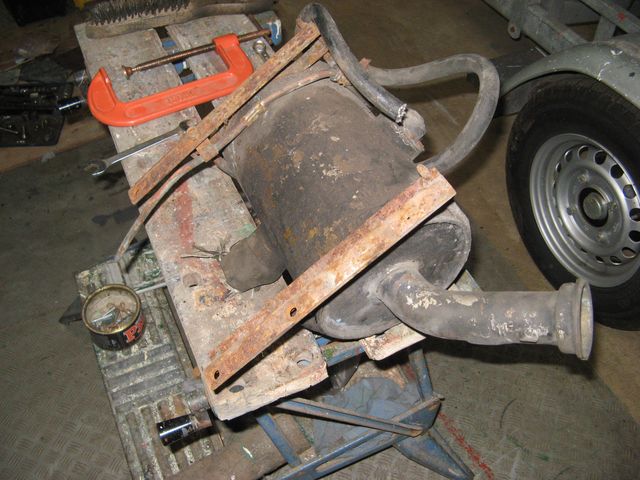
Fortunately, the straps for the radiator header tank are quite short; in fact two will come from one piece a metre long, with a tail-wind, and pieces of round steel that long are cheap and easily posted. The problem with bending metal is working out what radius you need, because the spring in the cold metal relaxes and the part comes out much bigger than expected. After a total failure based upon rational principles, I was forced to ad-lib and found a piece of broken cast-iron water main on the scrap pile next door, which did the job admirably! Now I need to cut to length and thread the ends, but that's simple enough. It looked nice when threaded through the painted and-re-assembled bracket assemblies. Another little job that was completed recently was the mysterious, long bolt which passes through the chequer-plate at the forward end of the exit step-well. It's about 4" long, and passes right through the adjacent floor-bearer assembly. My guess is it was part of the retro-fitted reinforcement of the step-well area due to the famous weaknesses identified in service. Sourcing a long bolt looked troublesome, so I simply threaded the end of a 5/16" round rod and asked my neighjbour to weld a nut on. It was then cut to length and threaded at the other end and fastened in place with a new nyloc nut. Job done! Moving towards completion of the bodywork is also important now, and the big area for attention is the rear gutter moulding and window. A chilly morning was spent in drilling out the remains of old screws and glueing into place dowels of maximum diameter ready for new screws. Without removing the rear dome moulding the proper approach of installing larger plugs (as done on the front dash, for example) is not possible. So long as the screws get some purchase they will simply expand the dowels into any residual space. However, in a couple of places I have encountered un-drillable 'residua', most probably broken drill bits left by my predecessors. "So it goes", as Kurt would say. I have taken a radical step and purchased a 5mm diamond bit, which should be able to get through the 'residua' fairly cleanly. Fortunately, the fixing holes in the gutter are for countersunk screws, so there is some latitude on the diameter. I realised that while I was up there, re-instating the rear number blind winder would be a good idea, so went to find the bits - which I did, and they were all seized-up. However, I also found a spare winder mechanism which my father had not only removed from MBS541, but apparent refurbished and lubricated as well, so it winds smoothly and easily, which is a joy because the complex set of helical gears are not something I want to tangle with! |








|
BACK .......to the index. |
FORWARD .......to continue the diary. |